

Extract fans & continuous extract — MEV
Extract that moves what it is supposed to move
A fan is rated on a test bench with nothing attached to it. What matters is what it moves once it is on your wall, through your duct, against your weather — and the difference between those two figures is where almost every disappointing bathroom fan lives. We measure the second one and write it down.
Noise is not airflow
Almost everybody judges an extract fan by how loud it is. It is the only feedback the thing gives you, so it is a reasonable instinct — and it is wrong. A fan straining against a long, crushed, badly routed duct can be moving half of what it should while sounding identical to one that is working perfectly. Some of the noisiest fans on the market move very little air, and some of the quietest move a great deal.
The figure on the box is what the fan achieved on a test rig with nothing connected to it. Every metre of duct, every bend, every squashed run of flexible and every blocked louvre takes something off that, and nothing about the installation tells you how much. The only way to know is to put a hood on the grille and read it.
That is the whole difference between a fan being fitted and a job being finished. It takes a few minutes, we do it on every extract job we complete, and you get the number afterwards in writing.
Four different things
Which kind of extract your room actually needs
“An extractor fan” covers four products at four prices, and which one suits a room is decided by the building rather than by preference.
- A wall fan where the wet room has an outside wall behind it. Sleeve right through the masonry and a backdraught shutter on the far end — the part everybody leaves off, and the reason a cheap fan rattles in the wind. A couple of hours a room.
- An inline fan where the room is in the middle of the plan with no outside wall. The fan sits in the ceiling void and ducts out to the nearest face. Most of a day with a ceiling open, and that is the price difference nobody is shown before the quote.
- Continuous extract (dMEV) — a fan that runs quietly all the time and boosts when the room is used. It deals with the twenty minutes after a shower, which is when most of the water is still in the air and the switch has already been turned off.
- Central MEV — one unit in the loft or a cupboard with a duct to every wet room. One unit and one set of filters rather than four fans, and it is usually the right answer once you are past two or three of them.
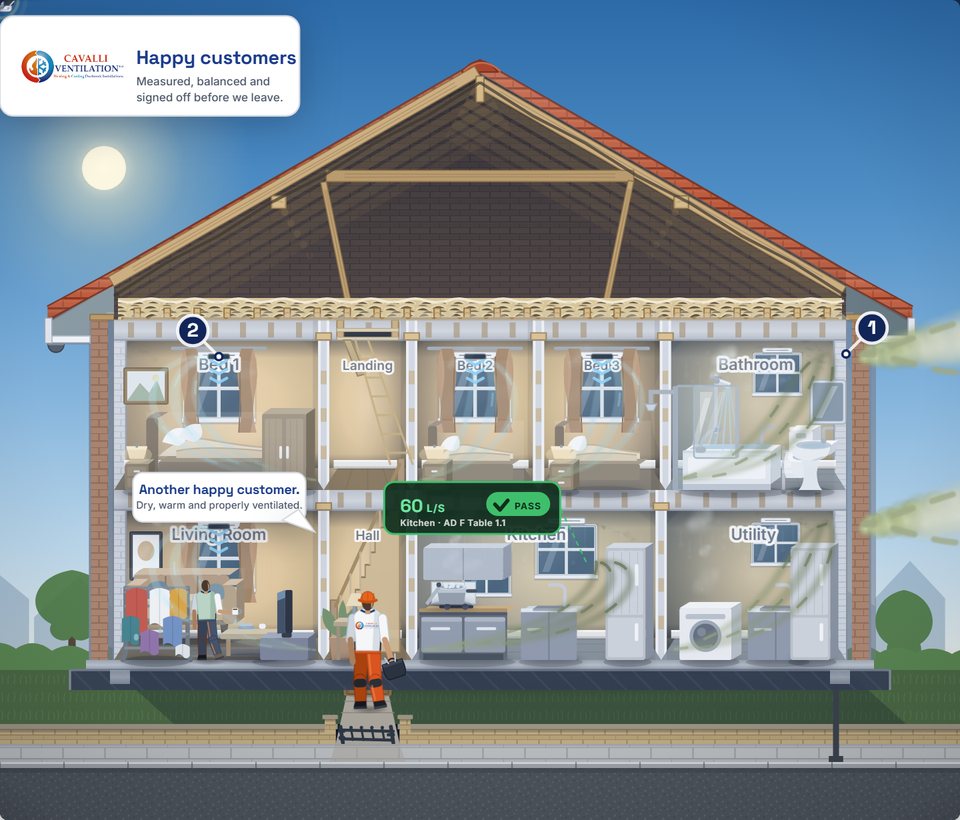
The two things that go wrong
Where it goes, and how the air gets back in
It has to discharge outside the building. A duct that stops in the loft is common, invisible from inside the house, and does real structural damage — every shower puts its water into the roof timbers instead of outdoors. You can check yours with a torch. If the duct ends in mid-air, or it reaches a tile vent but has come off it, that is what is wetting your roof.
And the house has to be able to let air back in. A fan can only push air out if the same volume can get in behind it. In a sealed-up house, the fan spends its life pulling against a closed room and moves a fraction of what it should — which is why fitting a bigger fan into the same house so often changes nothing at all. Background ventilation is half of the job, not an optional extra.
Where that means vents in the window frames, a glazier cuts those rather than us, and we tell you the size the rooms need. Where it means an air brick reinstated or an existing wall vent unblocked, that is our work and it goes on the quote.
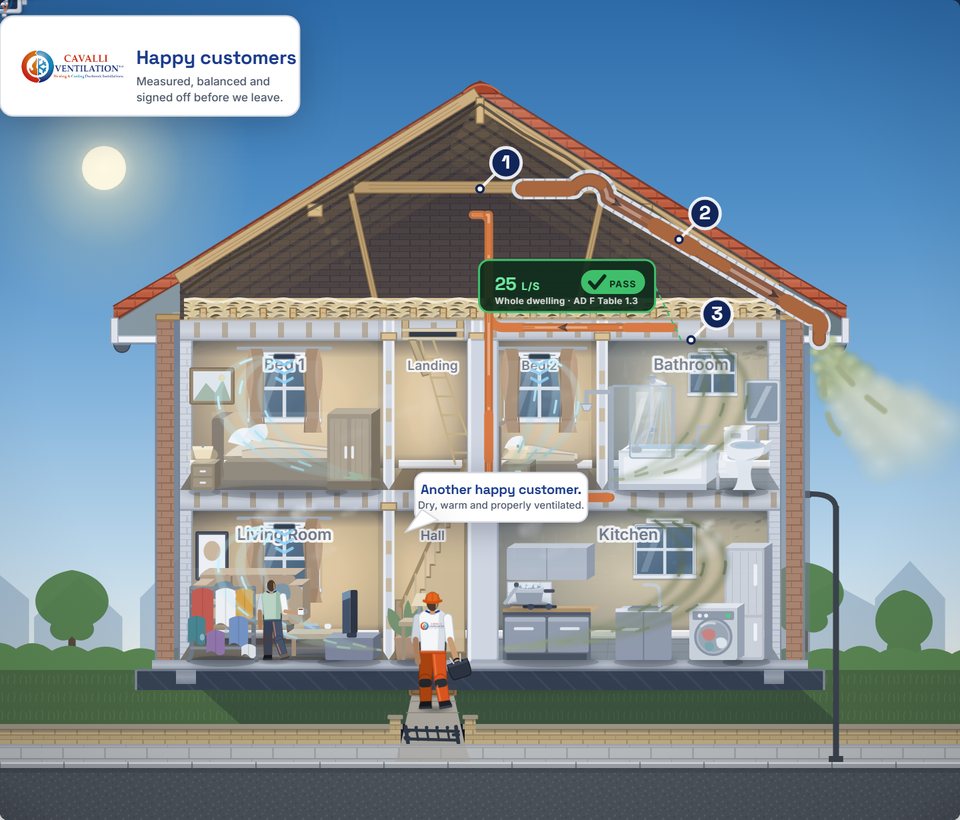
How the job runs
A single fan is a morning. A whole-house MEV is a day or two. Both finish the same way, with a reading.
-
Look at the route
Where the fan can go, where the duct can run and where it can discharge — before anything is priced. That is what separates a two-hour job from a full day.
-
Set the rate
The rate the room needs comes from Table 1.1 of Approved Document F. The figure for a kitchen turns on whether the cooker hood extracts to outside — a recirculating hood sits over the hob and does not count.
-
Fit it properly
Sleeve through the masonry, backdraught shutter outside, duct in rigid or semi-rigid rather than crushed flexible, insulated wherever it crosses cold space, and every joint banded.
-
Measure it
A flow hood on the grille, the reading taken and recorded against the figure the room is supposed to achieve.
-
Say what else the house needs
If the replacement air has nowhere to come from, the reading says so — and you are told, rather than left with a new fan that behaves like the old one.
What you are handed at the end
- The measured rate at every grille, in writing
- The Approved Document F figure that rate is measured against
- Dated photographs of the duct route and the outside terminal
- What the background ventilation needs to be, room by room
- The make and model of what was fitted, and its warranty
- A QR label on a central unit linking to its own service record
What it costs
Fixed where the work is predictable, a range where the route or the unit decides the day. Every figure includes VAT and the parts.
£239 – £395
Depending on the unit chosen
Extract fan replaced, like for like
New fan, new grille, and an airflow test at the end so you know it moves what it should.
What moves it: whether the existing duct is sound. If it is not, it is the next card.
£450 – £1,100
Depending on the unit chosen
Extract fan with a new duct run
Where the duct has to be replaced or run for the first time — through a wall, or out through the roof space to a new terminal.
What moves it: the length of the run, and whether a ceiling has to come down to reach it.
£340 – £450
Depending on the unit chosen
Continuous extract fan (dMEV)
A fan that runs all the time on a trickle and boosts when the room is used, instead of starting and stopping with the light switch.
£450 – £750
Cooker hood ducted to outside
Taking a recirculating hood and giving it a real route out of the building.
What is in the figure: the ducting and the work. A new hood is added on top and depends on the one chosen.
Whole-house MEV is priced with the other systems on what it costs, and a survey that establishes the cause first is £390.
Where this sits next to the other options
Questions we get asked about extract fans
Three things cause this and all three are about the installation rather than the fan. The duct may be the limit — a long or crushed run, or a squashed length of flexible, takes far more off the airflow than most people expect, so a bigger fan on the same duct simply works harder against the same restriction. The air may have no way back into the house, in which case the fan is pulling against a sealed room. Or the duct may not be reaching outside at all. A reading at the grille tells you which of the three you have in about five minutes, and the answer is usually cheaper than the fan you just bought.
Go into the loft with a torch and follow the duct from above the bathroom. It should run continuously to a terminal — a roof tile vent, a soffit louvre or a grille in a wall — and be properly connected at both ends. What we find instead, regularly, is a duct that stops in mid-air, or one that reaches a terminal and has come off it. Every shower then puts its water into the roof timbers instead of outdoors. From inside the house it is invisible: the fan sounds exactly the same.
Approved Document F sets a rate for each kind of room, and it is what we measure against. The figures are on our damp and mould page along with what they mean. The one worth knowing about is the kitchen, because the figure turns on whether the cooker hood extracts to the outside, not on where the hood sits — a recirculating hood is directly over the hob and does not count, so that kitchen needs the higher rate.
An inline fan in the ceiling void, ducted out to the nearest face that can take a terminal. It is a bigger job than a fan through a wall — usually most of a day, with a ceiling open — and it is the right answer for a single internal wet room. Where there are two or three of them, a central MEV unit with a duct to each one is normally better value: one unit and one set of filters instead of three fans, and one discharge point instead of three. Which of the two suits your flat is decided by where the plant could go and how far it is from an outside wall.
A fan wired to the light switch, even with a run-on timer, is off for most of the day and running at the moment the room is least steamy. Most of the water from a shower is still in the air for a while after everybody has left and shut the door. A continuous fan runs quietly on a trickle all the time and boosts when the room is in use, which deals with that period and keeps the moisture level down between uses. It is a modest amount more to fit and it is what we would put in our own bathroom.
No, and it is the single most misleading thing about them. Noise comes from the impeller, the mounting and the air passing through the grille, and a fan can be loud while moving very little. It is why we measure rather than listen — and it is also why a properly installed system can feel like it has been turned off when it has not. If yours is loud, that is worth fixing on its own terms, but it tells you nothing about the airflow.
Not sure where to start?
Send us a message with what you have noticed at home. We will tell you honestly whether you need a survey, a system, or neither.
Or see what it costs — unlike most in this trade, we publish our prices.
Trained on the systems we install
Certificated — and here they are
Most trade sites show you a row of logos. These are the actual certificates, both sat in August 2026. Tap either one to read it, or download the PDF.
- 12-month workmanship guarantee On top of the manufacturer’s warranty, which we register in your name. If anything we installed fails because of the way we installed it, we come back and put it right. What it covers.
- Company no. 12092552 Registered in England & Wales. Trading as Cavalli Ventilation since July 2019, and in ventilation since 2003.
- Airflow measured on every install A calibrated anemometer at the grille, recorded and handed over. The only figure that counts is the one measured in your room.