Message us on WhatsApp

What we do

Ventilation, designed and commissioned properly

Domestic and commercial work across South East London — with the airflow measured at the grille, not assumed from the box.

Domestic and commercial ventilation, heating and cooling — designed properly, installed neatly, and commissioned so the airflow is measured rather than assumed.

MVHR Installation

Whole-house mechanical ventilation with heat recovery — designed, ducted and balanced so every room gets its share without throwing your heating out of the window.

  • Whole-house MVHR design and installation
  • Semi-rigid radial and rigid duct systems
  • Commissioning with measured airflow at every valve
  • Filter changes and servicing afterwards
Ductwork Installation

Rigid and spiral ductwork, sized and routed to keep resistance and noise down. Set out square and bracketed properly — because on an exposed run the setting-out is the finish.

  • Round spiral ductwork
  • Square and rectangular ductwork
  • Plastic ductwork and flat channel
  • Small-bore and semi-rigid tubing
  • Fabric duct socks
  • Insulated and acoustically lined runs

AHU & Fan Coil Units

Air handling units and fan coil units set, connected and commissioned — plinths, anti-vibration mounts, flexible connections and access left where the next person can actually reach it.

  • Air handling unit (AHU) installation
  • Fan coil unit (FCU) installation
  • In-line and mixed-flow fan installation
  • Attenuators, dampers and access panels

Extract Systems

Bathroom, kitchen and utility extract that meets the Part F rate at the grille, not just on the box. Ducted to outside properly, never into a loft void.

  • Continuous mechanical extract (MEV)
  • Intermittent extract fans
  • Positive input ventilation (PIV)
  • Commercial and kitchen extract

Air Conditioning

Installation and planned maintenance for split and multi-split systems — filters, coils, condensate and performance checked before the hot weather finds the fault for you.

  • Air conditioning installation
  • Servicing and planned maintenance
  • Filter, coil and condensate cleaning
  • Fault-finding and performance checks

Maintenance Plans

A system nobody services stops doing what it was installed to do, quietly. Pick the interval that suits the kit and we book it in rather than waiting for you to notice.

  • Three-monthly service visits
  • Six-monthly service visits
  • Annual service visits
  • Reactive call-outs for existing customers

Damp & Mould Surveys

Measurement first: humidity, surface temperatures and actual extract rates. You get a written report on what is causing it, not a guess and a quote for a bigger fan.

  • Humidity and surface temperature readings
  • Measured extract rates at every terminal
  • Written report with the cause named
  • Landlord and managing-agent reports

Commercial Fit-Out

Supply and extract for units, venues and workspaces — coordinated with the other trades so the ductwork lands where the ceiling design says it should.

  • Warehouse and industrial unit ventilation
  • Gyms, venues and hospitality
  • Offices and workspace fit-out
  • Food production and clean spaces

Landlord Damp & Mould — Awaab’s Law

Investigation, a written report naming the cause, the fix, and a dated evidence trail — because the question is no longer whether you fixed it, but whether you can show what you did and when.

  • Damp and mould investigation with recorded readings
  • Written report against the Approved Document F minimums
  • Extract, MEV, PIV or MVHR remediation
  • Commissioning certificate with the measured rate at each valve
  • Every document dated and downloadable from the client portal
How this works for a portfolio
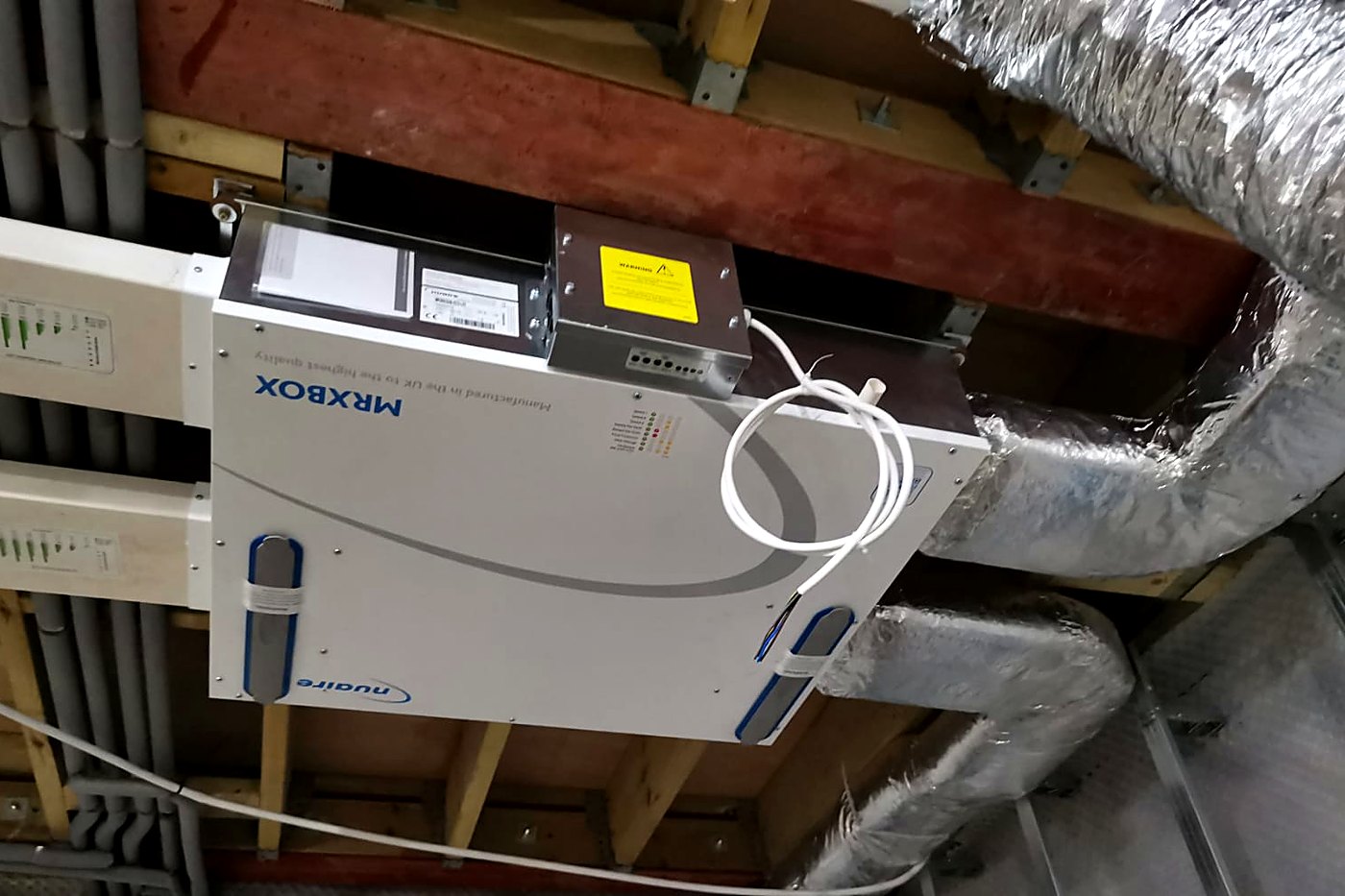
A Nuaire MRXBOX heat recovery unit suspended in a ceiling void between timber joists, with insulated ducting run over the top of it
MRXBOX heat recovery unit, suspended in the ceiling void.
  1. 1 Ceiling joists
  2. 2 Heat recovery unit
  3. 3 Insulated duct

Heat recovery

Fresh air without paying to heat it twice

An MVHR unit extracts damp air from your wet rooms and supplies filtered fresh air to the bedrooms and living space, passing the two streams either side of a heat exchanger so most of the warmth stays in the house.

It only works if the ducting is right. Insulated where it runs cold, kept as short and straight as the building allows, and balanced room by room at commissioning — otherwise you have an expensive box moving the wrong amount of air.

See how it works in your home

Heat recovery, in section

Where the warmth goes

An extract fan throws your heating out through the wall. A heat recovery unit takes the warmth out of the stale air on its way past and hands it to the fresh air coming in. Scroll to follow one lungful of air all the way through the machine.

OUTSIDE INSIDE — CEILING VOID BEDROOM BATHROOM Condensate drain, trapped HEAT RECOVERY UNIT 21°C from kitchen & bathroom 6°C leaves cold 3°C outdoor air 18°C delivered to the bedrooms WHAT IS INSIDE 1 Filter on each incoming stream 2 Counter-flow heat exchanger 3 One fan each way, balanced 4 Insulated — outdoor runs only 1 2 3 4 Heat crosses. The air does not.
  • Insulated — outdoor runs only
  • Filter on each incoming stream
  • Counter-flow exchanger

Illustrative figures at 85% heat recovery on a 3 °C day. The real numbers depend on the unit and the duct layout, and are proved by measurement at commissioning — not by the brochure.

  1. 1

    Extract · 21 °C

    The damp air leaves first

    A valve in the bathroom ceiling pulls air out continuously — from the rooms where the moisture is actually made. It leaves at room temperature, taking the moisture with it before it reaches a cold wall and turns into condensation.

  2. 2

    Exhaust · 6 °C

    It gives up its warmth on the way out

    Through a filter, through one half of the exchanger, through the fan and out to the wall grille. By the time it reaches the outside it is close to outdoor temperature — the warmth you paid for has been left behind in the unit.

  3. 3

    Intake · 3 °C

    Cold fresh air comes in the other side

    Filtered outdoor air enters through its own grille, set well away from the exhaust so the unit can't breathe back in what it has just thrown out, and runs into the other half of the exchanger. The plates keep the two streams apart: heat passes between them, air never does.

  4. 4

    Supply · 18 °C

    It arrives warm, where you sleep and sit

    The warmed fresh air is delivered to the bedrooms and living room. That is the whole trick: the full air change the regulations ask for, without paying to heat the house twice — which is exactly what an extract fan on its own makes you do.

For landlords, letting agents and estate agents

Damp and mould — and the evidence that you dealt with it

A black bathroom ceiling is not really a decorating problem. It is a disrepair claim, a renegotiated sale, a void month, or a tenant who has stopped answering the phone — and by the time it is any of those, the question is no longer whether you fixed it. It is whether you can show when you were told, what you found, what you did and when you did it.

That is a record-keeping problem as much as a ventilation problem. Most contractors hand you a paper invoice and nothing else. We do both halves, and the record builds itself.

If you are the landlord

The Homes (Fitness for Human Habitation) Act lets a tenant take you to court directly, and damp and mould is a category 1 hazard. Repainting it is not a defence — the cause has to be dealt with, and you need to be able to prove it was.

You get a report naming the cause and a commissioning certificate proving the fix works.

If you are the letting agent

You are the one taking the call, and you are carrying it with the landlord and the tenant at the same time. What you need is one contractor who goes out, reports back in writing, and gives you something you can forward the same afternoon.

You get a dated record per property, in an account you can pull it out of at any time.

If you manage a block

Communal extract that has not been touched since it was fitted, flats with no working ventilation, and a Section 20 to get through before anything can happen. A specified job with a measured outcome is a great deal easier to consult leaseholders on than “we will put some fans in”.

You get a survey of the whole block, a specification you can consult on, and figures at the end that show what was actually delivered.

If you are the estate agent

A survey that flags condensation or mould takes the momentum out of a sale and puts a number in the buyer’s head. Nine times in ten it is a ventilation shortfall, not rising damp — and that is a fixable, provable, quotable thing.

You get a fast survey, a written cause and a fix that closes the point out before exchange.

Surveyors and damp specialists: if you diagnose but do not install, send it over. We do not survey for damp causes in competition with you — we take the ventilation half, do it properly, and hand your client back a measured figure with your name still on the diagnosis.

What that looks like on a job

Step one

Go out and measure it

Not a look and an opinion. A damp and mould survey with the readings written down as they are taken: relative humidity, surface temperatures at the cold spots, moisture readings, and the airflow the existing extract is actually achieving.

Why it matters

A measured airflow is the difference between “there is a fan in there” and knowing whether it moves the air the room needs. Most of the ones we test do not.

Step two

Put the cause in writing

A written report naming the cause, not the symptom — a ventilation shortfall against the Approved Document F minimum, a cold bridge, a defect, or an occupancy load the fabric cannot carry.

Why it matters

“Tenant lifestyle” is the answer that ends up in front of a judge. A figure against a standard is the answer that ends the argument.

Step three

Fix it and prove it

Extract upgrades, continuous mechanical extract, positive input, or full heat recovery where the property warrants it — then commissioning with a calibrated anemometer and a certificate of the rate measured at each valve.

Why it matters

A system that meets the figure on paper regularly fails on site. The certificate is what stops the same property coming back next winter as a claim.

And the paperwork lands with it

  • RAMS and method statementIssued from our own system for every job, signed online.
  • Survey reportThe cause, the readings behind it, and what it needs.
  • Commissioning certificateThe rate measured at each valve, against the Part F figure.
  • Dated photographsBefore, during and after, timestamped as they were taken.
  • Quotes and invoicesApproved online, downloadable years later.

Awaab’s Law does not apply to you yet

Worth saying plainly, because plenty of people will imply otherwise. Awaab’s Law is named after Awaab Ishak, who died in 2020 after prolonged exposure to mould in his family’s flat. It came in through the Social Housing (Regulation) Act 2023, and the first phase of it took effect for social landlords on 27 October 2025 — fixed legal timescales to investigate a reported damp or mould hazard, report the findings in writing and start the work.

For privately rented homes it is not in force. The Renters’ Rights Act 2025 gives the government the power to extend it, and the published roadmap puts that in a later phase, subject to consultation. No commencement date has been set. Anyone telling you there is one is guessing.

It is worth knowing now, because the record it will ask you for is the record you should be keeping anyway — and the properties that will struggle are the ones with no before-and-after figures on file. Everything above already produces that record. Nothing needs to change when the timescales land.

Not legal advice. Awaab’s Law currently applies to social housing; the extension to privately rented homes under the Renters’ Rights Act follows its own timetable, and the regulations are amended from time to time. Check the current position, or take advice, for what applies to your properties today. What we can tell you precisely is what a property needs under Approved Document F, and prove by measurement that it is achieving it.

Included with every job

The evidence trail builds itself

We built our own engineer’s app, and every client gets the portal side of it. It is not a brochure — it is where the job actually lives, and the readings land in it as the engineer records them on site.

The reason that matters when you manage property is simple: the record you would have to produce is the same record we have to keep anyway to do the job properly. So you get it as a by-product, dated, rather than reconstructing it from an invoice eighteen months later when somebody asks.

See the client portal
  • No chasing. Every property, every job and every stage in one list. You stop spending Friday afternoon ringing round to find out what happened at Flat 3.
  • Documents where you can find them. Reports, quotes, invoices, commissioning certificates and RAMS, downloadable any time — including three years later when a claim, an inspection or a sale needs them.
  • Damp cases with the readings behind them. Not a verdict, the numbers. Humidity, surface temperature and measured airflow, with the dates they were taken on.
  • Approve a quote in a click. And sign RAMS and variations online, so a job is not held up waiting for a wet signature to come back in the post.
  • One thread per job. Message the engineer against the job itself, so the history is attached to the property rather than buried in somebody’s inbox.
  • Where the money goes. Fixing the cause once costs less than repainting the same ceiling every spring, and a measured commissioning figure is what stops the same property coming back as a claim. The portal is what lets you prove which of those you bought.

One property or two hundred — tell us what you have and where, and we will tell you what it needs.

Talk to us about a portfolio
Servicing and maintenance

A system that met the figure on handover is not still meeting it

Ventilation is the only thing in a house that quietly stops working without ever breaking. Nothing trips, nothing leaks, nothing makes a noise — the filters load up, the airflow halves, and the first anyone knows is a black line round the bathroom ceiling two winters later.

So we do not sell a callout. We sell a visit that ends in a measured figure, the same way the installation did.

MVHR

Filters to the manufacturer’s interval, heat exchanger drawn and cleaned, condensate trap checked, and the unit re-balanced — then every valve re-measured and the figures written down.

A loaded filter set can take a third off the airflow before anyone notices. Re-measuring is the only way to know it is still doing what it was commissioned to do.

Extract fans and MEV

Performance tested at the grille with a calibrated anemometer against the Approved Document F rate for that room, cleaned, and re-commissioned. If it cannot make the figure, you get told why.

Most of the fans we test in older properties do not hit their rate. A test is what turns “there is a fan in there” into something you can act on.

PIV

Filter changed, airflow checked at the diffuser, heater and controls tested, and the loft conditions round the unit looked at while we are up there.

A PIV pushing through a blocked filter is a fan heating a loft. They are cheap to service and almost never are.

Air conditioning

Filters, coils, condensate and drainage, electrical connections and a performance check before the hot weather finds the fault for you.

Refrigerant circuit work — recovery, charging and leak testing — is carried out under F-Gas certification by our refrigerant partner, because it is illegal to do otherwise. The work listed above needs no F-Gas certificate and we do it ourselves.

For a managed portfolio

One visit per property per year, planned round the summer rather than squeezed into the winter when everything else is going wrong. Each one ends with a dated certificate carrying the measured figures, filed against that property in your account.

That is the record that answers a complaint before it becomes a claim: not “it was serviced”, but what it was achieving, on what date, against what standard.

Ask about a service plan
  • Scheduled, not chased. We come to you with the year’s list, you say yes.
  • One certificate per property. Measured figures, dated, downloadable.
  • Flagged before it fails. Anything heading for a problem gets quoted, not hidden.
  • Access sorted with the tenant. Booked directly, so you are not the middleman.
For builders, loft converters and developers

First fix to your programme, and the paperwork for sign-off

You do not need the ventilation lecture. You need the ductwork in between the joists before the boards go on, on the day you said, and the numbers for building control at the end of it.

  • First fix to programme. Ducted in the void, supported properly and pressure-sound before it disappears.
  • Designed to Part F, not guessed. Rates worked out for the finished layout, including the rooms you are adding.
  • Commissioning certificate for the pack. Measured at every valve, which is what building control asks for and what most jobs cannot produce.
  • Loft conversions especially. Turning a cold loft into a bedroom moves the dew point and changes the whole house’s ventilation. It is the single commonest way a house that was fine develops a mould problem.
Talk to us about a programme

First fix

The work that decides whether it ever performs

Ventilation is won or lost before the ceiling goes on. Once plasterboard is up, the duct route is fixed, and a run forced around a joist it was never planned for will cost you airflow for the life of the building.

We set out first fix against the drawings and the other trades — joist positions, service voids, where the soil pipes and cabling are already going — so the ducting takes the shortest sensible route rather than the last gap left over.

Talk to us before first fix
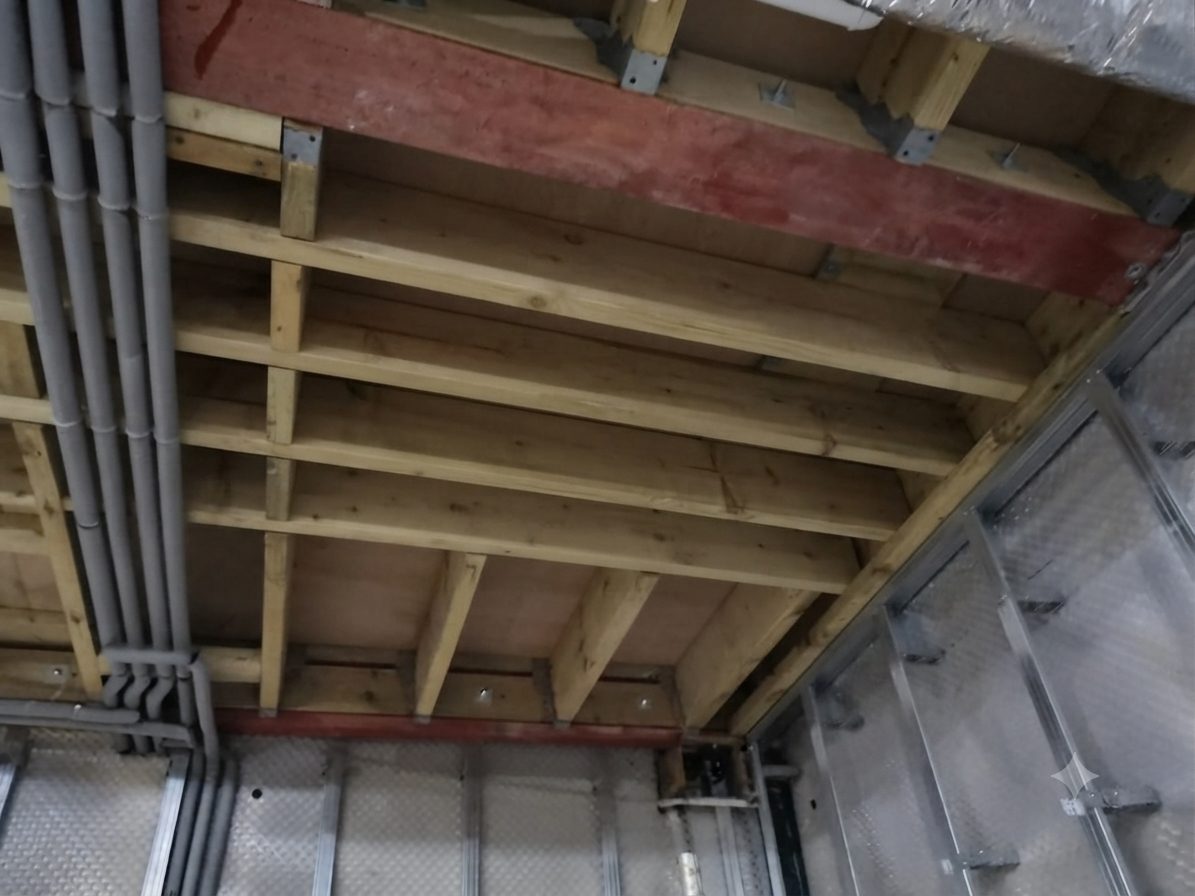
Ceiling void at first fix, with joists, soil pipes and insulated ducting set out before boarding
Ceiling void at first fix, before boarding.
  1. 1 Joists set out
  2. 2 Soil pipes already run
  3. 3 Duct route kept clear

Not sure where to start?

Send us a message with what you have noticed at home. We will tell you honestly whether you need a survey, a system, or neither.

Trained on the systems we install

Certificated — and here they are

Most trade sites show you a row of logos. These are the actual certificates, both sat in August 2026. Tap either one to read it, or download the PDF.

  • Company no. 12092552 Registered in England & Wales. Trading as Cavalli Ventilation since July 2019, and in ventilation since 2003.
  • Airflow measured on every install A calibrated anemometer at the grille, recorded and handed over. The only figure that counts is the one measured in your room.