
Positive input ventilation — PIV
Positive input ventilation: one unit, the whole house, and no ducts to every room
A PIV sits in the loft or on a wall, filters air and pushes it gently into the house, so the damp air that was sitting in the corners is diluted and pushed out through the gaps it was always leaving through. It is the least disruptive whole-house system there is, it is the cheapest, and there are houses it is not the answer for. This page says which.
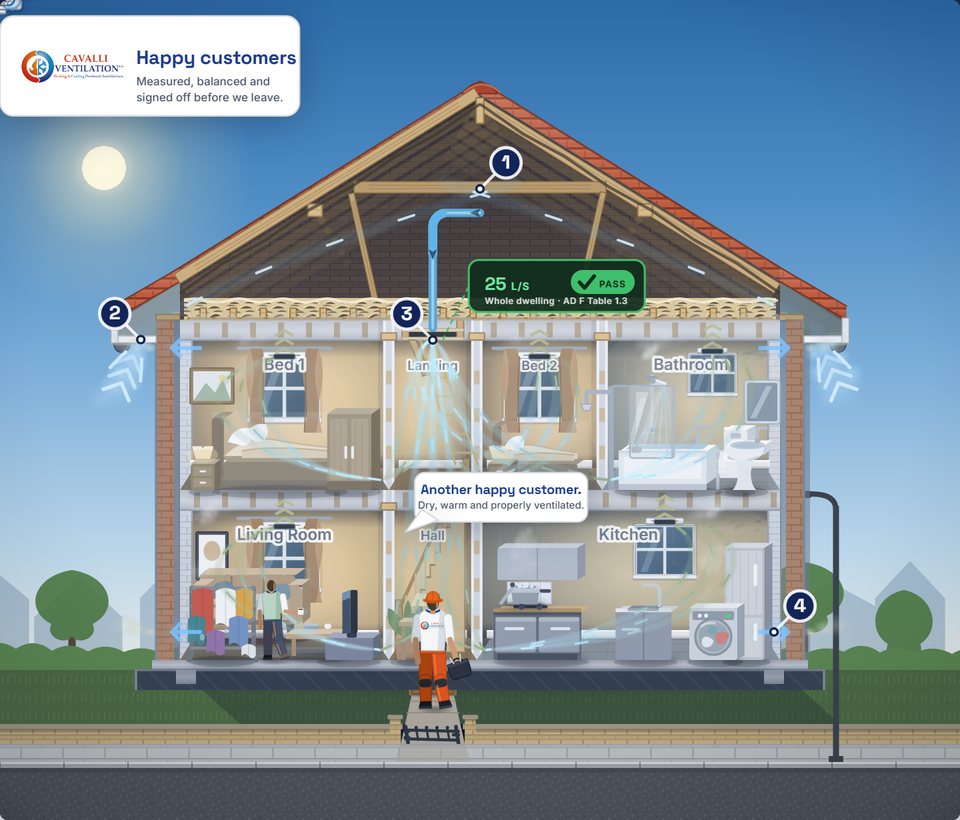
Why pushing air in works
Every other system on this site pulls stale air out. A PIV does the opposite: it pushes filtered air in, very gently, all the time. That slightly raises the pressure inside the house — by an amount nobody can feel — and the air already in there has to go somewhere. It leaves through the vents, the gaps and the openings it was always leaving through, taking the moisture with it.
The effect is dilution. Instead of a still, saturated pocket of air sitting in the cold corner behind a wardrobe until it condenses, the whole volume of the house is turned over continuously. Surfaces stay above the temperature at which water forms on them, and mould has nothing to grow on.
It is one unit, one diffuser, no ductwork to any room and usually half a day’s work. For a house whose problem is condensation on cold surfaces, it is very often the whole answer, and it costs a fraction of what heat recovery does.
Where it goes
In the loft, or on the wall where there is no loft
In a house with a loft, the unit sits on the joists and draws through its own filter from the roof space. That is deliberate rather than a shortcut: loft air is tempered by the sun on the tiles and by the heat leaking up through the ceiling, so in winter it lands softer than air taken straight off a cold wall. One diffuser in the landing ceiling feeds the whole floor.
In a flat, or a top-floor conversion with no loft above it, the same job is done by a wall-mounted unit — typically in the hall, drawing through a core straight out to the outside face. It is the answer nobody mentions when they tell a flat owner that a PIV is not possible, and it is fitted in a morning.
- Nothing runs to the bedrooms. No ceilings down, no boxing, no ducts through joists.
- A ducted intake is the exception — where the loft is not somewhere you would want to breathe from. It is quoted separately because the price depends on the route.
- Heated models exist and are worth discussing where the diffuser is above a landing somebody walks through in the morning.
The honest part
Three things that decide whether it will work in your house
A PIV is cheap enough that it gets sold to everybody, and that is exactly why it has a mixed reputation. It is an excellent product used in the right building. Here is what we check before recommending it, and any of the three can rule it out.
- The air has to have a way out. Push air into a house with every vent sealed, every chimney capped and every window tight, and it has nowhere to go. Background ventilation is part of this job, not an afterthought.
- A loft unit is only as good as the loft. Block the eaves — which happens every time somebody tops the insulation up and pushes it into them — and the unit is moving stale loft air around the house. We look at that before quoting.
- It is not extract. A shower running behind a closed door still puts its water into that room. A PIV deals with the house; the wet rooms still want their own fan, and Part F still asks for one.
Where the problem is a leak, a failed damp-proof course or water coming in from outside, a PIV changes nothing at all — and we would rather say so on the survey than sell you one. That is what the readings are for.

How the job runs
Usually half a day, and in an occupied house. Nothing comes down and nothing is chased into a wall.
-
Survey
Humidity, surface temperatures and the extract rates you already have, plus a look in the loft: is it ventilated, is the insulation in the eaves, is there a safe position over the landing.
-
Position and route
Unit sited where it can be reached again for a filter, diffuser centred on the landing or hall ceiling, and the background ventilation the house needs identified in writing.
-
Fit
Unit mounted and isolated from the structure so it does not hum through the ceiling, the ceiling cut once, the diffuser fitted, and the unit connected to a suitable electrical supply.
-
Set and measure
The unit set to the rate the dwelling needs, measured at the diffuser with a flow hood, and the reading written down.
-
Handover
What it costs to run, when the filter wants changing, and a QR label on the unit so its service history lives with it.
What you are handed at the end
- The measured rate at the diffuser, in writing
- The humidity readings taken before it went in
- The filter spec and the interval it wants changing at
- What the background ventilation needs to be, room by room
- A QR label on the unit linking to its own service record
- Dated photographs of the loft and the installation
What it costs
£900 – £1,350
Depending on the unit chosen
PIV unit fitted
Loft or wall unit, diffuser, electrical connection and the airflow measured at the end. The unit itself is most of the spread — a standard loft unit and a heated one are different money, and we tell you which we are proposing and why before you commit.
What moves it: a ducted intake, where the loft is not somewhere to draw air from. That is quoted on the route rather than folded in.
£390
Damp and mould survey
Where you want the cause established first: humidity, surface temperatures and measured extract rates, with a written report naming what is actually happening.
Worth knowing: if it is not a ventilation problem, the report says so and tells you which trade you need.
Both figures include VAT and materials. The full list is on what it costs.
Where this sits next to the other options
Questions we get asked about PIV
It should not, and where it does, something is wrong with how it was set up. The unit moves air continuously and gently rather than in a blast, and a loft unit is drawing air that has been tempered by the roof space rather than straight off a cold wall. The two things that cause complaints are a unit running harder than the dwelling needs and a diffuser positioned directly over somewhere people stand still — both are decided at installation. Where a landing genuinely is a cold spot, a heated model is the answer and we will say so before you buy the other one.
Yes. A wall-mounted unit does the same job: it is fitted in the hall, usually at high level, and draws its air through a core straight out to the outside face rather than from a roof space. It is a morning’s work. What decides it is whether there is a suitable outside wall within reach of a sensible position, and whether you are allowed to put a terminal on that face — in a block that is usually the freeholder’s or managing agent’s decision, and it is worth asking before anything is ordered.
Yes. A PIV deals with the whole house; it does not deal with a shower running behind a closed bathroom door, where the water goes straight onto the nearest cold surface within a few minutes. Approved Document F still asks for extract in the wet rooms, and in practice that is where the moisture is actually made. The two work together rather than competing — and if you are having both done, it is one visit rather than two.
Insulation itself is not the problem; insulation pushed into the eaves is. A loft unit breathes the roof space, so the roof space has to be ventilated — and the commonest thing we find is that a top-up of loft insulation has been pushed out into the eaves and closed the gap the roof was relying on. That is a cheap thing to put right, it is worth doing whether or not you fit a PIV, and we check it before quoting rather than afterwards.
It is a cure for one kind of damp. Condensation — moisture made inside the home landing on cold surfaces — is what a PIV deals with, and that is the commonest cause of mould in the housing round here by a wide margin. Water coming in through a wall or a roof, or moisture drawn up from the ground, are different problems with different fixes, and ventilation changes nothing about either. They look very similar from inside the room, which is why the survey takes readings instead of guessing, and why the report tells you which of the three you have even when the answer means we are not the trade you need.
Not sure where to start?
Send us a message with what you have noticed at home. We will tell you honestly whether you need a survey, a system, or neither.
Or see what it costs — unlike most in this trade, we publish our prices.
Trained on the systems we install
Certificated — and here they are
Most trade sites show you a row of logos. These are the actual certificates, both sat in August 2026. Tap either one to read it, or download the PDF.
- 12-month workmanship guarantee On top of the manufacturer’s warranty, which we register in your name. If anything we installed fails because of the way we installed it, we come back and put it right. What it covers.
- Company no. 12092552 Registered in England & Wales. Trading as Cavalli Ventilation since July 2019, and in ventilation since 2003.
- Airflow measured on every install A calibrated anemometer at the grille, recorded and handed over. The only figure that counts is the one measured in your room.